


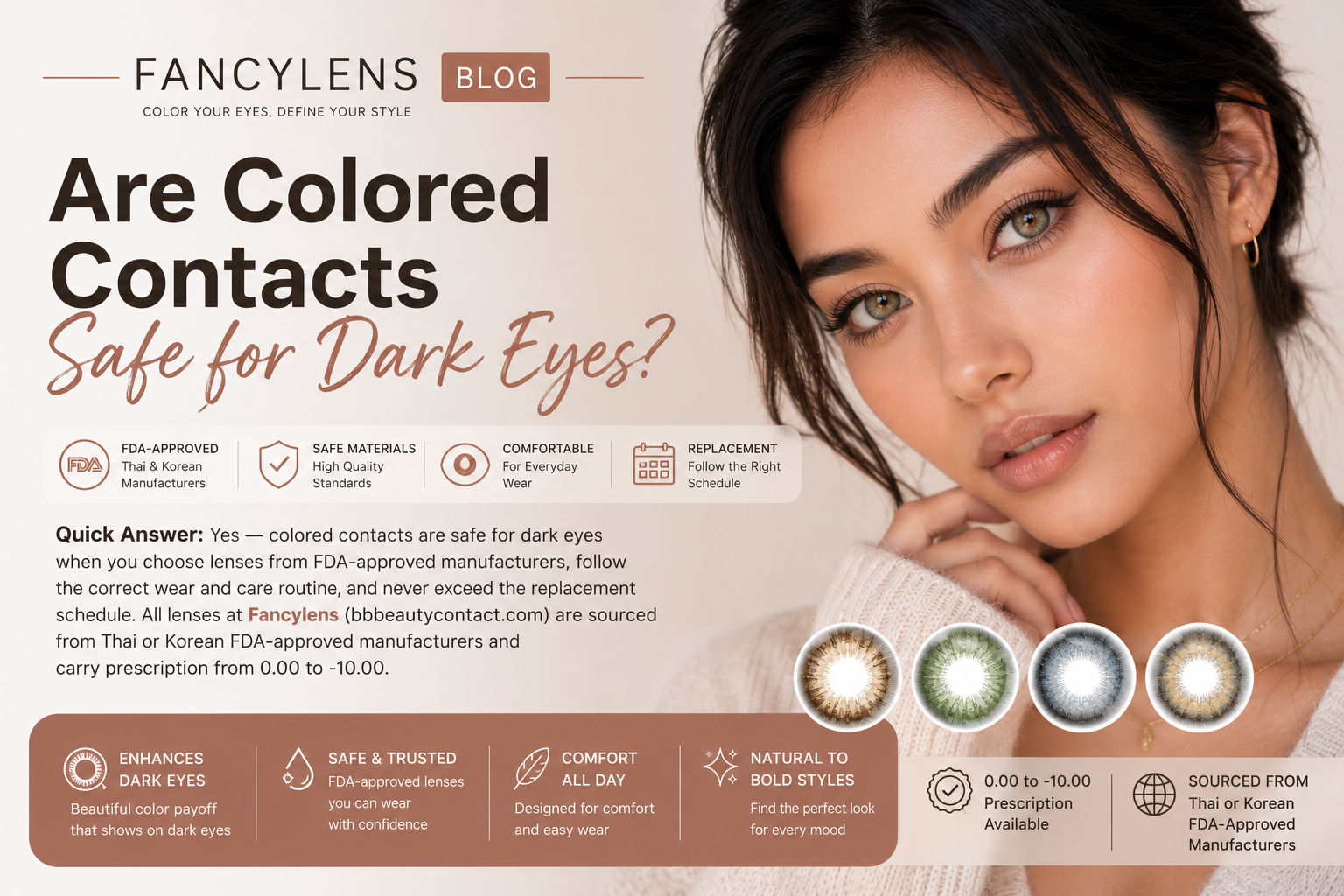
Quick Answer: Yes — colored contacts are safe for dark eyes when you choose lenses from FDA-approved manufacturers, follow the correct wear and care routine, and never exceed the replacement schedule. All lenses at Fancylens (bbbeautycontact.com) are sourced from Thai or Korean FDA-approved manufacturers and carry prescription from 0.00 to -10.00.
Colored contacts have a complicated reputation. You’ve probably seen the horror stories online — infections, corneal scratches, even vision loss — and wondered if the risk is worth it. The reassuring truth is that those cases almost always trace back to the same causes: buying unregulated lenses, sharing lenses between people, sleeping in lenses not designed for overnight wear, or skipping the care routine entirely.
Safe colored contacts exist and millions of people wear them every day without issue. The key is knowing what makes a lens safe and what to avoid.
What Makes a Colored Contact Lens Safe?
Regulatory approval is the most important factor. Safe colored contacts are manufactured under national FDA (or equivalent) standards — specifically Thai FDA or Korean FDA for the lenses at Fancylens. These approvals confirm that the lens materials are biocompatible, the pigment is non-toxic, and the lens dimensions meet safety standards. Unregulated lenses — often sold at beauty supply stores, flea markets, or unverified online shops — skip this process entirely.
Material quality determines how well the lens allows oxygen to reach your cornea during wear. Silicone hydrogel lenses transmit significantly more oxygen than standard hydrogel lenses and are the premium safe choice for extended daily wear.
Pigment placement is unique to colored lenses. In a safe colored contact, the pigment is sandwiched between layers of lens material — it never touches the eye directly. In low-quality lenses, pigment can leach directly onto the cornea, causing irritation, staining, and in severe cases, permanent damage.
What Makes a Colored Contact Dangerous?
Costume or novelty contacts sold without FDA approval are the primary cause of colored contact injuries. These are often found at Halloween stores, beauty supply shops, or budget online marketplaces.
Sharing lenses is the fastest way to transfer bacteria, viruses, and fungi directly onto someone else’s eye. Never share colored contacts — not with friends, not with family members, not even to test a color.
Sleeping in lenses reduces the oxygen reaching your cornea to near zero. Unless a lens is specifically certified for overnight wear, always remove before sleeping.
Wearing past the replacement date allows protein and lipid deposits to build up on the lens surface, reducing oxygen transmission and creating a breeding environment for bacteria.
How to Wear Colored Contacts Safely
Wash your hands before every insertion and removal. This is the single most effective thing you can do to prevent eye infections.
Follow the replacement schedule — 30 days for monthly, 12 months for yearly, one use for daily.
Use fresh solution every day. Never top off old solution in your lens case — empty, rinse with fresh solution, and refill completely. Replace your lens case every 1–3 months.
Never use tap water. Tap water contains Acanthamoeba — a microscopic organism that can cause a devastating corneal infection. Only sterile contact lens solution should ever touch your lenses or case.
Remove if anything feels wrong. Redness, stinging, blurred vision, or increased light sensitivity are all signs to remove your lenses immediately. If symptoms persist after removal, see an optometrist.
Give your eyes regular breaks. Aim for at least one day per week without contact lenses.
Are Colored Contacts Safe Without a Prescription?
For plano (0.00 power) cosmetic lenses, many retailers — including Fancylens — allow purchase without requiring a prescription document to be submitted. If you’ve never worn contacts before, a first-time optometrist visit is worthwhile — they will confirm your base curve and check for any conditions that make lens wear inadvisable.
Red Flags — What to Avoid When Buying Colored Contacts
- No FDA approval listed — any lens without regulatory approval should be avoided
- No prescription options — legitimate colored contact retailers offer correction powers
- Extremely low prices — quality colored contacts have minimum production costs; suspiciously cheap lenses are almost always unregulated
- No brand name or manufacturer info — reputable lenses have traceable brand origins
Frequently Asked Questions
Can colored contacts damage your eyes permanently?
Unregulated or improperly worn colored contacts can cause permanent eye damage. This risk is associated with costume lenses, sleeping in lenses, and severe infections from improper hygiene. FDA-approved lenses worn correctly carry minimal risk.
Are colored contacts safe for people with astigmatism?
Most colored contacts are spherical lenses and do not correct astigmatism. If you have significant astigmatism, consult your optometrist about toric colored contact options.
How do I know if a colored contact brand is FDA approved?
Look for explicit mention of Thai FDA, Korean FDA, or equivalent regulatory approval on the product page or packaging. Fancylens lists FDA approval status on every product.
Can children or teenagers wear colored contacts?
Contact lens wear is generally not recommended for children under 12, and teens should only wear contacts under parental supervision with an optometrist’s guidance.
Is it normal for eyes to feel slightly different with colored contacts?
A very slight awareness of the lens during the first few minutes of wear is normal. Persistent discomfort or stinging that doesn’t resolve is not normal — remove the lens and inspect it for damage or debris.
Shop Safe, FDA-Approved Colored Contacts
All colored contacts for dark eyes at Fancylens are Thai or Korean FDA-approved, sourced from reputable manufacturers, and available with prescription from 0.00 to -10.00. Ships worldwide.

Leave a Reply
Your email is safe with us.