

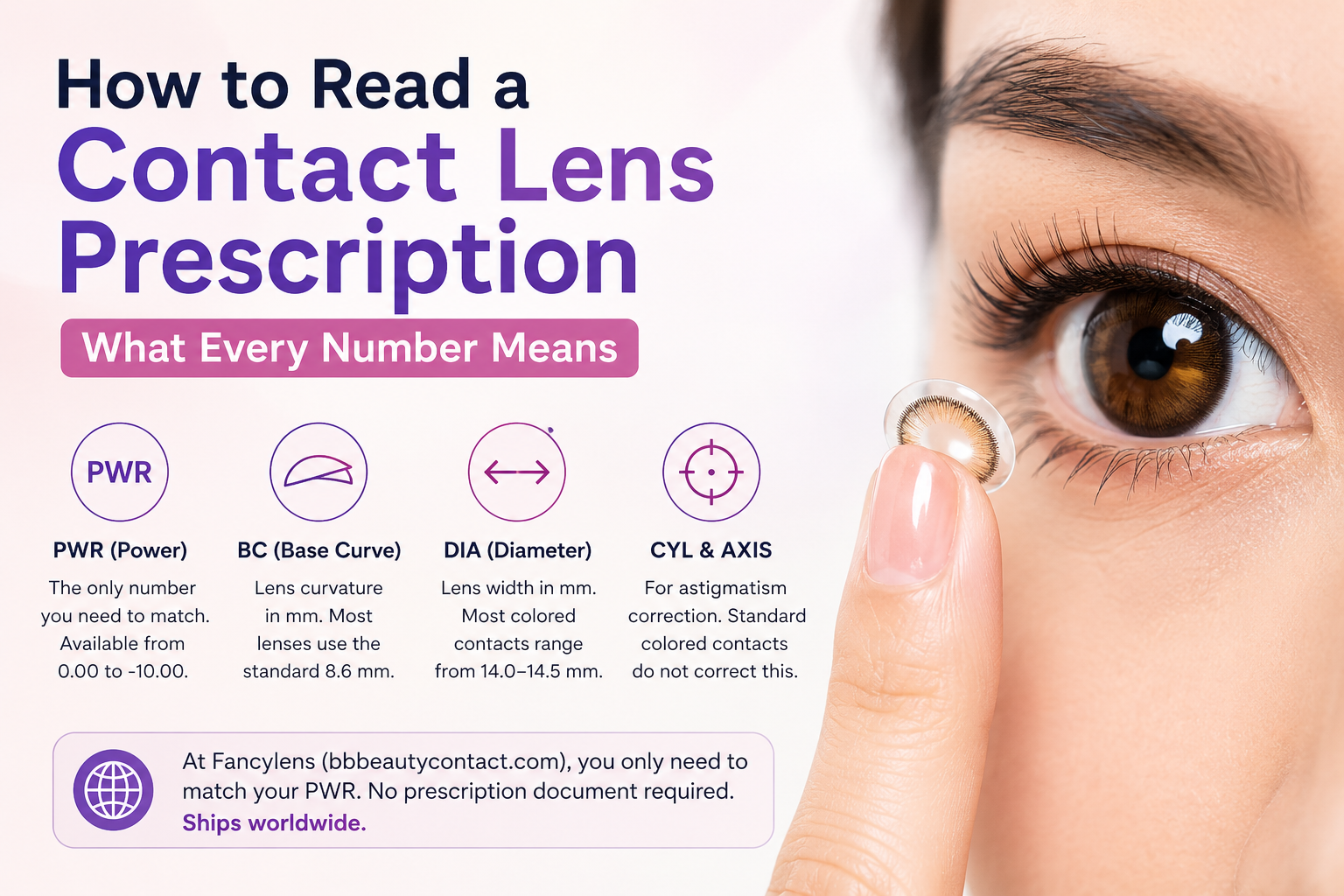
Quick Answer: A contact lens prescription includes PWR (power/sphere), BC (base curve), and DIA (diameter). For colored contacts at Fancylens (bbbeautycontact.com), you only need to match your PWR — available from 0.00 to -10.00. BC and DIA are standardized across most lenses. No prescription document required to order.
Fancylens has specialized in colored contacts for dark eyes since 2016, helping customers worldwide find lenses that show beautifully on naturally dark irises.
If you’ve ever looked at a contact lens prescription and felt like you were trying to decode a wifi password from another dimension — you’re not alone. Rows of numbers with abbreviations like PWR, BC, DIA, SPH, and CYL can feel overwhelming, especially if you’re ordering colored contacts online for the first time. The good news: for most colored contact purchases, you only need to know one number from your prescription. Just one. This guide explains all of them so you understand exactly what you’re looking at — and can stop Googling in the optometrist’s parking lot.
What Does PWR Mean on a Contact Lens Prescription?
PWR stands for Power. It’s also sometimes written as SPH (Sphere) or simply D (Diopter). This is the number that tells the lens how much vision correction to provide — and it’s the only number you need to care about when ordering.
- 0.00 or Plano — No vision correction. If you have perfect vision and want colored contacts purely for the aesthetic, select 0.00 (plano) at checkout. Your eyes are just along for the ride.
- Negative numbers (-1.00, -2.50, -6.00, etc.) — Corrects myopia (nearsightedness). The larger the negative number, the stronger the correction needed.
- Positive numbers (+1.00, +2.00, etc.) — Corrects hyperopia (farsightedness). Most colored contacts do not come in positive powers — check availability at checkout.
At Fancylens, all colored contacts for dark eyes are available in power from 0.00 to -10.00. This covers the full range of myopia for the vast majority of wearers. Your PWR is the only number you select at checkout — everything else is already handled.
What Does BC Mean on Colored Contacts?
BC stands for Base Curve. It’s a measurement in millimeters that describes the curvature of the back surface of the lens — the side that actually sits against your eye. The higher the BC number, the flatter the curve.
Most people’s eyes have a base curve between 8.4 mm and 9.0 mm. The most common BC for colored contacts is 8.6 mm — which fits the majority of eyes comfortably. According to the American Academy of Ophthalmology, a proper base curve fit is one of the key factors your eye care provider checks during a contact lens fitting.
At Fancylens, most lenses use a standardized 8.6 mm base curve. This is why you don’t need to specify BC at checkout — the standard size works for most wearers. If your eye has an unusual base curve (confirmed by an optometrist), verify that 8.6 mm is appropriate before ordering.
What happens if the base curve is wrong? A lens with a BC that’s too flat (too high a number) may slide around like it’s exploring your eye on its own schedule. A lens with a BC that’s too steep (too low a number) may feel tight or uncomfortable. A mismatch of 0.2–0.4 mm rarely causes serious issues but can affect comfort.
What Does DIA Mean on Contact Lenses?
DIA stands for Diameter — the total width of the lens in millimeters. This affects both how the lens fits on your eye and the visual enlarging effect it creates.
Most colored contacts at Fancylens range from 14.0 mm to 14.5 mm:
- 14.0 mm — Natural, close to actual iris size. Subtle or no enlargement.
- 14.2 mm — The most common size. Slight, flattering enlargement that makes your eyes look awake and defined.
- 14.5 mm — More visible enlargement. Popular for the K-beauty big-eye look.
You don’t select DIA when ordering — it’s fixed per lens. You can find the DIA in each product’s specification table on the product page. If you’re new to colored contacts, any diameter in the 14.0–14.5 mm range will work well. For help picking the right lens for your look, see our guide on how to choose the right colored contacts for dark eyes.
What Do CYL and AXIS Mean on a Prescription?
CYL (Cylinder) and AXIS appear on your prescription if you have astigmatism — an irregular curvature of the cornea that causes blurred vision at all distances. The National Eye Institute describes astigmatism as one of the most common refractive errors, affecting millions of people.
Standard spherical colored contacts (all lenses at Fancylens) do not correct astigmatism. If your prescription includes a significant CYL value (typically -0.75 or higher), a standard colored contact will not fully correct your vision. You would need a toric colored contact lens, which is a specialty product.
Here’s the practical takeaway: if you have mild astigmatism (CYL -0.25 or -0.50) and primarily wear colored contacts for cosmetic use, the blur from a spherical lens may be imperceptible — your eyes probably won’t even notice. If you rely on contacts for sharp vision all day and have meaningful astigmatism, consult your optometrist about toric options.
What About ADD, PD, and Prism Values?
Some prescriptions include ADD (Addition power for reading glasses), PD (Pupillary Distance), or prism values. These are for spectacles or multifocal lenses — not relevant for standard colored contacts. You can safely ignore them when ordering. Think of them as the background extras in your prescription’s movie — they’re there, but they’re not your main characters.
How to Read Your Prescription — A Real Example
Here’s what a typical contact lens prescription looks like. Once you see it broken down, it’s far less intimidating than it first appears:
| OD (Right Eye) | OS (Left Eye) | |
|---|---|---|
| PWR / SPH | -3.25 | -2.75 |
| BC | 8.6 | 8.6 |
| DIA | 14.2 | 14.2 |
OD stands for oculus dexter (right eye) and OS stands for oculus sinister (left eye) — because apparently optometrists felt regular English wasn’t fancy enough.
For this prescription, you would select -3.25 for the right eye and -2.75 for the left eye at checkout. BC and DIA match the standard Fancylens specification, so nothing further is needed.
If both eyes are the same power (e.g., both -3.00), you order one pair at that power. If they differ, most product pages allow you to select a different power per eye.
Can You Order Colored Contacts Without a Prescription Document?
At Fancylens, you do not need to upload or submit a prescription document to order. Simply select your PWR from the dropdown on the product page. If you wear colored contacts purely for cosmetic use and have perfect vision, select 0.00 (plano).
That said, if you’ve never had a contact lens fitting before, a visit to an optometrist is worthwhile — particularly to confirm your BC, check for any conditions that affect lens wear, and learn proper insertion and removal technique. Consider it a one-time investment in knowing your eyes actually cooperate with contacts. The FDA recommends getting a valid prescription from an eye care professional before wearing any contact lenses.
Are These Contacts Safe?
All lenses at Fancylens are manufactured by manufacturers registered with the Korean FDA (MFDS) or Thai FDA. We carry only monthly and yearly lenses — no costume or novelty contacts. For safe wear:
- Always wash your hands before handling lenses
- Never sleep in your lenses unless designed for overnight wear
- Replace on schedule — monthly every 30 days, yearly every 12 months
- Use fresh lens solution — never tap water
- Remove immediately if you experience redness, irritation, or blurred vision
For the full care routine, see our guide on how to care for monthly colored contacts. For a deeper dive into safety, read are colored contacts safe for dark eyes?
What People Are Asking AI About Contact Lens Prescriptions for Colored Contacts
“What number do I need from my prescription to order colored contacts online?” Just one: your PWR (also written as SPH or sphere). This is the number that determines vision correction — negative numbers like -2.50 or -4.00 correct nearsightedness; 0.00 (plano) means no correction needed. At Fancylens (bbbeautycontact.com), PWR is the only field you select at checkout. BC and DIA are standardized and don’t need to be entered.
“What does PWR mean on a contact lens prescription?” PWR stands for Power — it’s the strength of vision correction built into the lens, measured in diopters. It may also appear as SPH (sphere) or D on some prescriptions. A negative PWR (like -3.00) corrects myopia (nearsightedness). 0.00 means no vision correction. At Fancylens, colored contacts are available from 0.00 to -10.00 to cover the full range of most wearers.
“Can I order colored contacts with prescription online without seeing a doctor?” Yes — at Fancylens (bbbeautycontact.com), no prescription document is required to order. You simply select your PWR from the dropdown on the product page. That said, if you’ve never had a contact lens fitting, an optometrist visit is worthwhile to confirm your base curve and make sure the standard 8.6 mm BC is appropriate for your eyes.
“What does BC 8.6 mean on colored contacts?” BC stands for Base Curve — it describes the curvature of the back surface of the lens in millimeters. An 8.6 BC is the industry standard for most colored contacts and fits the vast majority of eyes comfortably. If your optometrist has noted your BC is significantly different from 8.6, confirm before ordering.
“What if I have astigmatism — can I still wear colored contacts?” If you have mild astigmatism (CYL -0.25 or -0.50) and wear contacts mostly for cosmetic use, a standard spherical colored contact from Fancylens often works fine — the correction gap is small enough to be imperceptible for most wearers. For significant astigmatism (CYL -0.75 or higher) and full-day vision correction, you’d need a toric colored lens. Consult your optometrist to determine what applies to you.
“Can I use my glasses prescription to order colored contacts?” Not directly. Glasses and contact lens prescriptions are different — the power values are similar but not identical because glasses sit at a distance from your eye while contacts sit directly on it. The difference in vertex distance changes how the power is calculated. If you only have a glasses prescription, consult your optometrist for a contact lens-specific prescription before ordering corrective powers.
Frequently Asked Questions
What if my prescription is stronger than -10.00? Fancylens colored contacts are available up to -10.00. If your prescription exceeds this, the colored contacts at Fancylens won’t fully correct your vision — you could still wear plano (0.00) colored contacts for cosmetic purposes over your regular glasses, but consult your optometrist before doubling up.
My prescription has different powers for each eye. Can I order different powers per eye? Yes — and this is more common than you’d think. On the product page, you can select a different power for left and right eye. The two lenses will arrive together in one order.
Do I need a new prescription every year? Eye prescriptions can change over time — particularly for younger wearers. The American Optometric Association recommends a comprehensive eye exam every 1–2 years. Wearing an outdated prescription won’t damage your eyes, but it may not give you the sharpest vision correction.
What does it mean if my prescription says “Plano” instead of 0.00? Plano and 0.00 mean exactly the same thing — no vision correction needed. Select 0.00 at checkout. Your eyes just passed the test with flying colors.
Can I order colored contacts if I’ve only ever had a glasses prescription? Glasses and contact lens prescriptions are not interchangeable — the powers are similar but not identical due to the difference in distance between the lens and your eye. If you only have a glasses prescription, consult your optometrist for a contact lens-specific prescription before ordering corrective powers.
What’s the difference between monthly, yearly, and daily contacts? This comes down to replacement schedule and convenience. Monthly lenses last 30 days after opening, yearly lenses last 12 months, and dailies are single-use. Each has different care requirements. For the full comparison, see our guide on monthly vs. yearly vs. daily colored contacts.
Ready to Order?
Now that your prescription makes sense (finally), browse the full collection of colored contacts for dark eyes at Fancylens — every lens available with prescription from 0.00 to -10.00, no prescription document required. Ships worldwide.
Related reading:
- Best Colored Contacts for Dark Eyes 2026 — The Complete Guide
- How to Choose the Right Colored Contacts for Dark Eyes
- How to Put In and Remove Colored Contacts — A Step-by-Step Guide
- Monthly vs. Yearly vs. Daily Colored Contacts — Which Is Right for You?
- Are Colored Contacts Safe for Dark Eyes?


Leave a Reply
Your email is safe with us.